What's in This Guide
There's a particular kind of quiet that settles over you on a Kerala backwater. The engine hums low, the coconut palms lean in from both banks, and the only thing on the agenda is watching a kingfisher decide whether to move. It's not the sort of experience you need to sell very hard. Which probably explains why houseboat stays have become one of the most consistently requested components of any Kerala tour package — not just for honeymooners, but for families, solo travellers, and anyone who's been running at pace for too long.
So what makes these packages so enduringly popular? And when you book one, what are you actually getting?
The Backwaters Are Unlike Anything Else
Kerala's backwater network — a sprawling system of lakes, rivers, canals, and lagoons running parallel to the Arabian Sea coastline — covers roughly 900 kilometres. It connects villages, paddy fields, and fishing communities that have organised their lives around water for centuries. Travelling through it on a houseboat isn't tourism so much as a slow immersion into a way of life most visitors would never otherwise see.
That access is genuinely rare. You're not observing from a viewpoint or moving through it on a rushed tour bus. You're in it — waking up to mist on the water, eating meals on the deck as village life goes about its business along the banks, and going to sleep to the sound of the backwaters rather than a highway. No recreation of this experience exists elsewhere in India. That's not marketing language — it's simply a fact. And it's the core reason Alleppey houseboat packages, in particular, attract the volume they do. Alleppey (Alappuzha) sits at the heart of the network and is the most practical base for most itineraries.
Thinking of Adding a Houseboat Night to Your Trip?
Swastik Holiday can build a Kerala itinerary around Alleppey's backwaters, with the rest of your trip planned around it.
Explore Kerala Tour Packages →What a Standard Package Typically Includes
Most houseboat packages operate on a per-vessel, per-night basis rather than per person — which makes them reasonably good value for couples and small groups.
Here's what a standard package tends to cover:
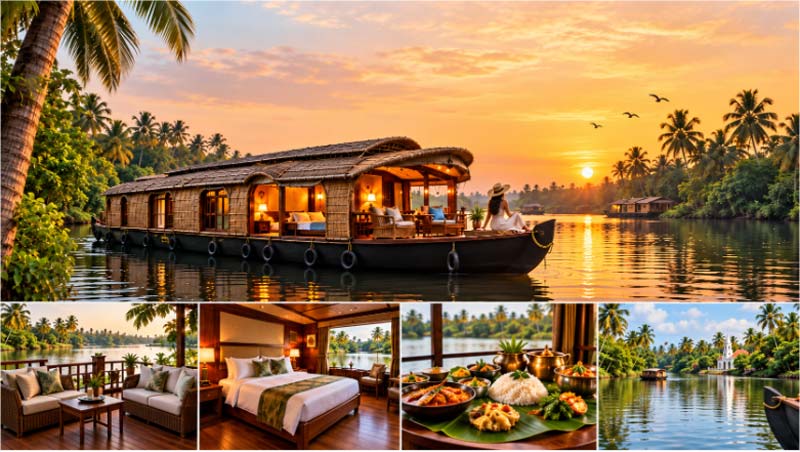
- The boat itself. Traditional Kerala houseboats — called kettuvallams — are built from bamboo, coir, and wood with thatched palm roofing. They range from single-bedroom boats to larger vessels with two or three cabins. Each comes with a sitting area, a dining space, and a sun deck at the front. Air conditioning is available on most boats but worth confirming.
- A dedicated crew. A standard package includes a captain, a cook, and in most cases a general helper. The cook prepares all meals on board, working from a small kitchen at the rear of the boat. This is not an afterthought — Kerala cooking at its most straightforward is genuinely good, and eating fish curry with rice on a moving houseboat has a way of becoming one of the more memorable meals of a trip.
- All meals. Most packages include breakfast, lunch, and dinner. Meals are typically Kerala-style — rice, fish or prawn curry, vegetable dishes, and a coconut-based side or two. Some operators let you request specific dishes or accommodate dietary preferences with advance notice.
- A fixed cruising route. Boats typically depart in the late morning and cruise through the afternoon, mooring for the night in a quieter stretch of the backwater. Most packages include around six to eight hours of active cruising per day.
- Transfers in some cases. Depending on the operator and the Kerala tour package you've booked through, transfers from your hotel or from Alleppey station to the boarding point may be included. Worth checking before you assume.
How to Choose the Right Package
The quality of houseboat packages varies considerably — more so than in most other categories of Kerala tourism. The difference between a well-maintained boat with a good cook and an older vessel that's seen better days can be significant, and pricing alone isn't always a reliable indicator.
A few things worth establishing before you book:
- The boat's age and condition matter. Ask for photographs, or look for operators who provide verified guest reviews rather than just promotional imagery.
- The boat's size relative to your group matters. A couple on a three-bedroom boat can feel slightly adrift; a family of five on a single-bedroom boat is the opposite problem.
- Whether the boat is certified by the Kerala Tourism Development Corporation (KTDC) or the District Tourism Promotion Council (DTPC) is a reasonable baseline check. Certification doesn't guarantee quality, but it does indicate that minimum safety and hygiene standards have been met.
A Practical Note on Timing
The backwaters are navigable year-round, but the experience shifts with the season. Between November and February, the weather is dry, and the light is clear — this is peak season, and prices reflect it. The monsoon months bring dramatically green scenery and a different kind of atmosphere, though some travellers find the continuous rain difficult over a full day on the water.
If you're building an itinerary around Alleppey houseboat packages, a one-night stay is the most common choice and genuinely sufficient. Two nights allow for a more extended route and a slower pace, which suits some travellers better — particularly those who've come a long way and want the experience to settle rather than rush past.
The backwaters will give you exactly as much as you're willing to slow down for. Most people, it turns out, are ready for that.
Ready to work a houseboat night into your own trip? Swastik Holiday's Kerala tour packages can build the backwaters into an itinerary alongside Munnar, Thekkady and Cochin. Browse more destination guides on our travel blog.
Frequently Asked Questions
1. Are Kerala houseboat packages priced per person or per boat?
Most operators price houseboats per vessel, per night, rather than per person. This generally makes them better value for couples and small groups than for solo travellers, since the cost is shared across everyone on board.
2. What is a kettuvallam?
A kettuvallam is the traditional Kerala houseboat, built from bamboo, coir, and wood with a thatched palm roof. Modern versions range from single-bedroom boats to larger vessels with two or three cabins, a sitting area, dining space, and a sun deck.
3. Are meals included in a Kerala houseboat package?
Yes, in almost all standard packages. A dedicated cook prepares breakfast, lunch, and dinner on board, typically Kerala-style with rice, fish or prawn curry, vegetable dishes, and coconut-based sides. Some operators accommodate dietary requests with advance notice.
4. Is one night on a houseboat enough?
For most travellers, yes. A one-night stay is the most common booking and covers a full afternoon of cruising plus an overnight mooring. Two nights suit those who want a more extended route and a slower pace.
5. What should I check before booking a houseboat?
Ask about the boat's age and condition, confirm its size suits your group, and check whether it's certified by the Kerala Tourism Development Corporation (KTDC) or the District Tourism Promotion Council (DTPC) as a baseline safety and hygiene check.